SEO Services FAQ
Built around years of organic search experience, these FAQs answer common questions business owners and marketing teams have when evaluating SEO services, including what SEO involves, how long it takes, how results are measured, and how search is changing with AI.
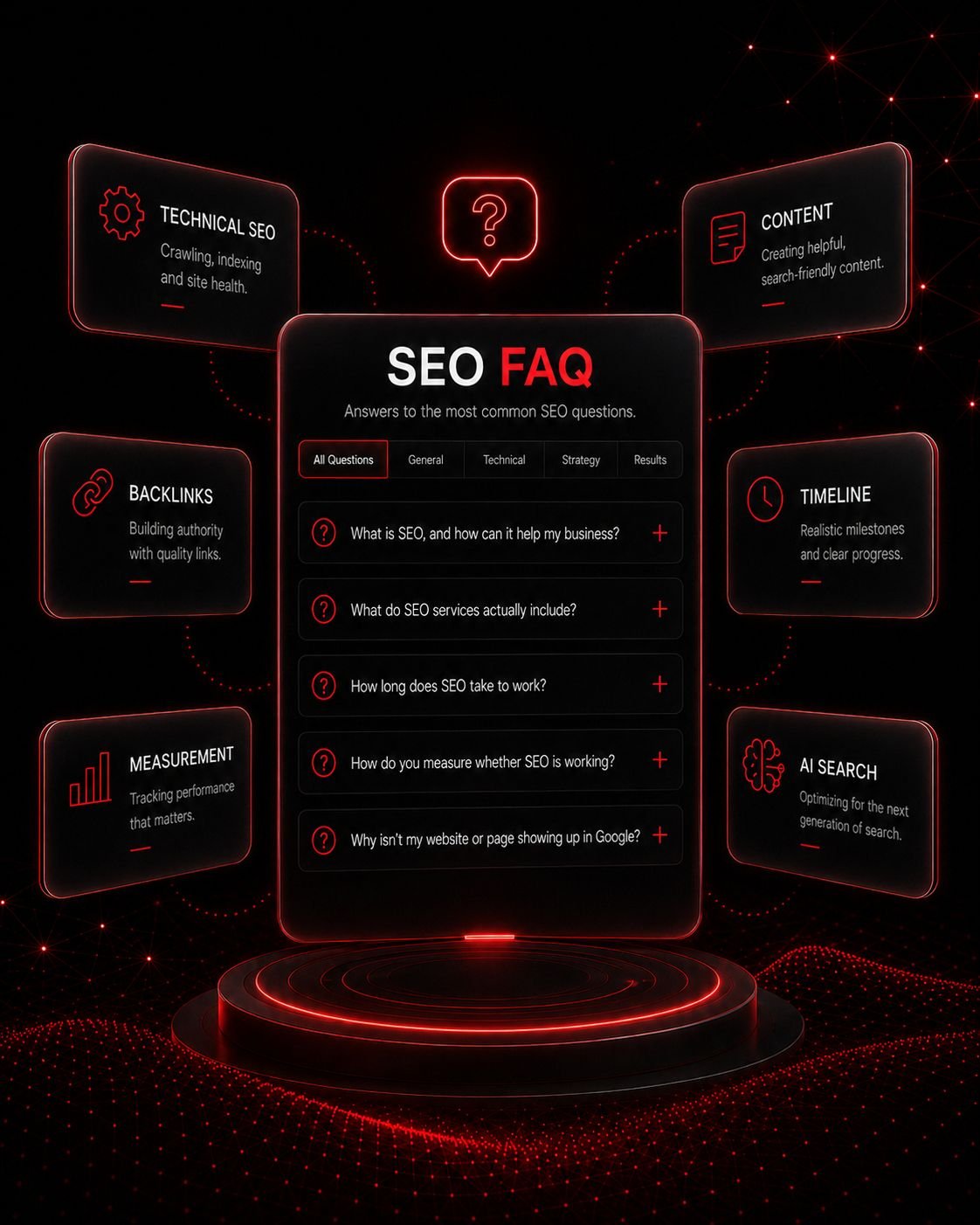
What is SEO, and how can it help my business?
Search engine optimization (SEO) is the process of improving a website so search engines can find, understand, and recommend its pages for relevant searches. The goal is not simply to attract more visitors, but to increase visibility among people actively looking for the products, services, or expertise a business provides.
Effective SEO brings together useful content, a technically accessible website, clear relevance to the searches that matter, and enough authority to compete with other pages targeting those searches.
What do SEO services actually include?
SEO usually combines several types of work that support one another:
- Technical SEO addresses crawling, indexing, site architecture, internal linking, mobile usability, page performance, structured data, XML sitemaps, and other technical issues.
- On-page SEO and content strategy improve page topics, headings, title tags, internal links, search-intent alignment, existing content, and opportunities for new pages.
- Local SEO strengthens visibility in the geographic markets a business actually serves through location strategy, Google Business Profile optimization, citations, reviews, and local relevance.
- Off-page SEO and authority building focus on relevant links, mentions, citations, and other signals that originate elsewhere on the web.
- Measurement and analysis track whether search visibility is translating into meaningful traffic, leads, conversions, and new opportunities.
The right mix of SEO work depends on the website, its technical condition, its market, its competitors, and the searches most important to the business.
How long does SEO take to work?
There is no universal SEO timeline. Competition, existing website authority, technical condition, content quality, website history, and the difficulty of the searches being targeted can all affect how quickly organic performance changes.
Some improvements, such as resolving a crawling problem or improving an existing page, can be completed relatively quickly. Broader growth in rankings, search visibility, traffic, and leads usually develops over a longer period as search engines recrawl pages, competitors change, new content earns visibility, and authority develops.
A useful SEO strategy should focus on measurable progress rather than promising a specific ranking by an arbitrary date.
How do you measure whether SEO is working?
SEO performance should be measured against the business outcome the work is intended to support, not rankings alone. Useful measurements can include:
- Organic leads, calls, sales, or other conversions
- Organic search traffic and landing-page performance
- Search visibility and rankings for relevant searches
- Google Search Console impressions and clicks
- Indexing and technical search health
- Local and Google Maps visibility when local search matters
Unified SEO Services uses tools such as Google Search Console and Google Analytics alongside ranking, landing-page, local visibility, lead, and conversion data. Reporting should help answer a practical question: what is improving, what is not, and what should be prioritized next?
Why is high-quality content important for SEO?
Search engines are designed to surface information that helps people complete a search or answer a question. Useful content gives a website a way to explain its services, answer customer questions, address specific needs, and demonstrate relevant knowledge or expertise.
Content also helps search engines understand which searches a page is a strong match for. Ranking for the right searches does not mean repeating keywords. Strong SEO content clearly covers the subject a searcher expects, uses the language people actually use, and provides enough useful information to deserve visibility over competing pages.
Content works best when each page has a clear purpose. A service page, location page, comparison, FAQ, and informational guide may target related subjects, but each should be built around the specific need behind the searches it is intended to serve.
What is technical SEO, and why does my website need it?
Technical SEO makes it easier for search engines to discover, crawl, render, understand, and index a website. It can involve site architecture, internal linking, mobile usability, page performance, canonicalization, redirects, indexing controls, XML sitemaps, structured data, and other technical elements.
A website can offer excellent services and publish strong content but still struggle in organic search if important pages are difficult for search engines to find or process. Technical SEO removes those barriers so content, on-page optimization, local relevance, and authority have a better foundation to work from.
For a full breakdown of what a complete evaluation covers, see our SEO audit guide.
Why isn't my website or page showing up in Google?
A page generally needs to be discovered, crawled, and indexed before it can appear in Google Search, and being indexed does not guarantee that it will rank prominently for a particular query.
Search engines can discover pages through internal and external links, XML sitemaps, and tools such as Google Search Console. Problems can occur at several different stages: a search engine may have difficulty finding the page, crawling it, indexing it, understanding what it should rank for, or determining that it is competitive enough to appear prominently.
Unified SEO Services approaches this type of problem by identifying the actual bottleneck before recommending additional work. A crawling or indexing problem requires a different solution from improving a page that is already indexed but lacks relevance, authority, or competitive strength.
Do backlinks still matter for SEO?
Backlinks are links from other websites to your website. Relevant links can help search engines discover pages, understand relationships between sites, and evaluate the authority supporting a webpage or domain.
Quality and relevance matter more than simply accumulating as many links as possible. A link from a credible website connected to a business, industry, location, or subject can be more meaningful than a large number of unrelated or low-quality links.
Backlinks are also only one part of SEO. Strong content, technical accessibility, search relevance, internal linking, and the overall quality of the website still matter. Authority building should support a broader organic search strategy rather than operate as a shortcut to rankings.
Does SEO need to be ongoing?
Not every SEO task needs to continue indefinitely. Technical repairs, website migrations, audits, or the restructuring of important pages can all be completed as defined projects.
Competitive organic visibility often requires ongoing attention because websites, competitors, customer search behavior, and search-engine systems continue to change. Ongoing SEO may involve:
- Monitoring search and conversion performance
- Improving pages that are gaining or losing visibility
- Creating new content where genuine search demand exists
- Resolving new technical or indexing problems
- Strengthening internal links and external authority
- Expanding into new services, topics, or geographic markets when the data supports it
Unified SEO Services does not treat ongoing SEO as a fixed list of tasks that must be repeated every month. Priorities should follow the problems and opportunities that can make the greatest difference to the website at that point in time.
Does SEO still matter now that people use AI search?
AI is changing how people discover information, but it has not removed the need for websites to be clear, useful, authoritative, and technically accessible. AI-powered search features can answer questions directly, summarize information from multiple sources, and introduce businesses to users without relying on a traditional list of organic results.
Clear business and service information, technically accessible pages, useful content, and explicit relationships between topics all help search and AI systems understand a website. A website should clearly explain who the business is, what it offers, which subjects it has relevant expertise in, and how its services, locations, people, and supporting information relate to one another.
SEO is therefore expanding beyond the goal of ranking a webpage for a keyword. The broader objective is to make a business and its information easy to discover, understand, and trust across the different search experiences people use.