
An SEO company should verify that search and measurement systems are working, interpret what changed, identify the highest-value constraint, implement or coordinate the appropriate work, validate implementation and outcomes, and explain the next decision every month. An SEO company should not automatically deliver the same number of articles, backlinks, title rewrites, or technical checks to every website every month.
The distinction between recurring SEO management and recurring SEO tasks matters because the two commitments are not the same. Measurement integrity, prioritization, implementation tracking, and clear communication require a stable cadence. Production work should change when the evidence changes. A site with missing service pages needs different work from a site whose important pages are excluded from Google. An indexed page with relevant impressions but weak clicks needs different work from a page that attracts traffic but no qualified leads.
Unified SEO Services uses an adaptive monthly SEO process for business owners and marketing teams that need accountability without buying a subscription box of disconnected tasks. The Unified SEO Services process reflects more than eight years of work across technical SEO, content strategy, local search, on-page optimization, internal linking, authority development, and performance measurement.
The repeatable monthly deliverable should be a defensible decision process, not an identical production quota. A strong SEO company repeats the method used to choose work while changing the work chosen by that method.
| Monthly function that should remain consistent | Evidence the SEO company should examine | Production work that may change |
|---|---|---|
| Verify search and measurement health | Tracking tests, Search Console messages, priority-page status, recent releases, and unexplained data gaps | Analytics repair, indexing correction, canonical cleanup, redirect repair, or no technical change |
| Evaluate organic-search outcomes | Relevant impressions, clicks, landing-page sessions, key events, qualified leads, sales, and local interactions | Snippet improvement, page revision, conversion work, intent correction, or continued observation |
| Review the search market | Result types, query patterns, competitor changes, local competitors, search features, and ranking-system updates | Existing-page work, new content, internal linking, local optimization, authority work, or no response |
| Select the highest-value constraint | Business value, evidence strength, affected scope, implementation readiness, risk, and measurement plan | One large correction, several page improvements, an asset campaign, or a controlled experiment |
| Track implementation and processing | Deployment dates, changed URLs, production output, crawl evidence, index state, and expected evaluation dates | Developer coordination, quality assurance, recrawl monitoring, or protection of an active measurement window |
| Report decisions and next actions | Completed work, observed effects, pending signals, blockers, and alternative priorities considered | Revised backlog, continued strategy, escalation, or a different next-month focus |
Google’s own documentation supports an evidence-dependent approach. Google states that some changes can affect search within hours while other changes can take months, and Google generally recommends allowing a few weeks before judging whether work helped. Google also notes that some SEO suggestions may not apply to a particular business. A monthly plan therefore needs explicit assumptions, deployment dates, and evaluation windows instead of constant activity for its own sake. Google SEO Starter Guide
An SEO Company Should Repeat a Decision Process Instead of a Task List
Standardized monthly SEO packages are easy to sell, budget, staff, and compare. A package can promise four articles, five backlinks, 20 optimized pages, one technical audit, and a report. Production counts create visible activity, but production counts do not prove that the activity addresses the website’s current constraint.
A production quota can even create the wrong incentive. A content quota rewards publishing after the useful content opportunities have been exhausted. A backlink quota rewards acquiring whatever links can be obtained before month-end. A page-optimization quota rewards changing pages that may already be working. A monthly full-audit quota rewards rediscovering known issues instead of implementing the highest-priority fix.
Articles, links, on-page changes, and technical checks can all create value. Standardized packages become unreliable when the package ignores the different condition each activity solves. A technically blocked service page does not need another supporting blog post. An indexable and relevant page that consistently loses to trusted alternatives may need authority more than another title rewrite. A local business with a verified profile but weak proximity coverage cannot solve distance by purchasing generic directory submissions.
Fixed SEO Packages Can Define Capacity Without Dictating Every Output
An adaptive retainer still needs a defined scope. A contract can specify available expertise, approximate production capacity, access requirements, meeting cadence, response expectations, approval responsibilities, excluded work, and the method used to choose priorities. A contract can also identify minimum recurring controls, such as measurement checks and implementation reporting.
A responsible scope might reserve capacity for technical SEO, content, local search, and authority work without promising that every category receives equal production every month. The monthly capacity allocation can change as long as the provider explains the evidence, tradeoff, and expected result.
Fixed output can remain appropriate when a real operational need repeats. A publisher may require a continuing editorial schedule. A franchise may need recurring profile governance across hundreds of locations. An ecommerce site may need routine monitoring after frequent product and platform releases. A migration may require a fixed validation program. Each recurring operational condition justifies the repeated output in its respective case.
Standardized SEO Deliverables Become Red Flags When Counts Replace Reasons
A monthly package deserves scrutiny when the provider cannot answer four questions:
- Which diagnosed problem does the deliverable solve?
- Why does the deliverable outrank other available work?
- Which page, query class, location, or business outcome should change?
- Which evidence will confirm that the deliverable worked?
An article count is a production commitment. A relevant-content plan explains which uncovered intent needs a page and how the new page connects to commercial destinations. A link count is an acquisition commitment. An authority plan explains why credible external recognition is the current bottleneck and which assets or relationships can earn that recognition.
The Unified SEO Monthly Constraint Cycle Turns Evidence Into Priorities
Unified SEO Services organizes ongoing work as a six-step Monthly Constraint Cycle. The six steps remain stable even when the selected work changes.
- Verify the operating environment. Confirm that analytics, Search Console, key events, forms, phone tracking, priority pages, and recent releases are producing trustworthy evidence.
- Compare meaningful outcomes. Review search visibility, searcher selection, landing-page behavior, qualified actions, local interactions, and revenue evidence at an appropriate comparison period.
- Diagnose the current constraint. Determine whether the next limitation involves measurement, technical eligibility, relevance, search-result selection, local prominence, authority, conversion, or implementation.
- Prioritize the available interventions. Compare business value, evidence confidence, affected scope, implementation cost, risk, and readiness.
- Implement and document the work. Record each change, URL, owner, deployment date, expected signal, and decision date.
- Validate and decide. Confirm that the work reached production, determine whether search systems processed the change, and continue, escalate, or change direction when the evidence supports a decision.
The Monthly Constraint Cycle prevents two costly behaviors. The Monthly Constraint Cycle stops a team from continuing low-value tasks because a package promised them, and the Monthly Constraint Cycle stops a team from changing direction every time a daily ranking fluctuates.
An SEO Priority Ladder Protects Preconditions Before Expansion
The priority ladder below identifies the usual order of constraints. Multiple teams can work in parallel, but later-stage work cannot compensate for an unresolved prerequisite on the same page or objective.
| Priority level | Condition the SEO company should test | Work that normally takes precedence |
|---|---|---|
| 1. Measurement integrity | Can the business trust the organic-search, local, lead, and revenue data? | Repair tracking, event definitions, attribution filters, call tracking, forms, or data annotations |
| 2. Availability and policy | Is the website available, secure, free from accidental removal, and clear of relevant manual or policy restrictions? | Resolve outages, security problems, manual actions, accidental removals, or production mistakes |
| 3. Discovery and index eligibility | Can Google find, crawl, render, index, and select the intended canonical page? | Repair links, directives, responses, rendering, canonicals, duplicates, or sitemap contradictions |
| 4. Relevance and intent | Does the correct page satisfy the query and represent the business accurately? | Improve the existing page, consolidate overlap, clarify entities, or build a missing destination |
| 5. Search-result selection | Do impressions fail to produce clicks from the right searchers? | Improve title presentation, page positioning, intent fit, rich-result eligibility, or offer clarity |
| 6. Authority and prominence | Does a relevant, eligible page lose to stronger or more recognized alternatives? | Strengthen internal support, original evidence, credible mentions, links, reviews, and reputation |
| 7. Expansion | Have priority pages earned enough support to justify entering additional topics or markets? | Create new content, new service destinations, new location coverage, or new authority assets |
The Unified SEO Services website-visibility guide explains why discovery, crawling, rendering, indexing, canonicalization, relevance, and authority require different remedies. A monthly SEO company should preserve the same diagnostic separation when deciding where to spend the next block of work.
Indexing Problems Should Override Routine Content Production
Indexing data should change monthly priorities when important pages cannot participate in search. An SEO company should first distinguish a meaningful indexing loss from an expected non-indexed URL. The Crawled, Currently Not Indexed guide explains how to make that distinction using Search Console evidence.
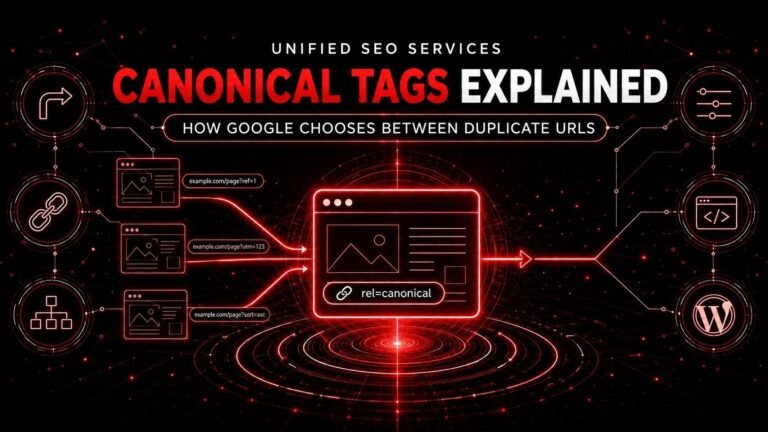
Google explicitly says that website owners should not expect every URL to be indexed. Duplicate URLs, filtered pages, removed URLs, intentionally excluded pages, and other low-value variations can remain outside the index for legitimate reasons. Google states that the goal is to have the canonical versions of important pages indexed. Google Page Indexing report For more on how Google selects that canonical URL from a duplicate cluster, see the Canonical Tags Explained guide.
A monthly report that celebrates a higher percentage of indexed URLs can therefore reward the wrong outcome. Indexing 5,000 parameter URLs can increase a count while making the site harder to manage. Losing indexation for five revenue-producing service pages can matter more than thousands of expected exclusions.
Site Size Should Determine the Depth of Monthly Indexing Analysis
Google says a site with fewer than 500 pages probably does not need routine use of the Page Indexing report; Google recommends checking key pages and using the URL Inspection tool when a small site needs page-specific diagnosis. A large ecommerce, publisher, marketplace, or programmatic site can justify automated and directory-level index monitoring because a template change can affect a large URL population. Google Page Indexing report Google URL Inspection guidance
The monthly technical depth should therefore match the website’s scale and rate of change:
- A stable 30-page service website may need priority-page checks, release review, and anomaly monitoring rather than a ceremonial full crawl every month.
- A 30,000-page ecommerce site may need automated monitoring for status codes, canonicals, robots directives, internal-link changes, structured data, and index patterns.
- A recently migrated site may need temporary intensive monitoring until redirects, canonicals, indexation, and traffic stabilize.
- A JavaScript application may need recurring rendered-output tests after component and deployment changes.
An Indexing Failure Should Produce a Recovery Test, Not Another Audit Export
An SEO company should state which URLs are affected, why the status is harmful, what caused the status, who owns the fix, and what evidence will confirm recovery. Search Console’s Page Indexing report can monitor issue patterns, while URL Inspection can compare Google’s indexed information with a live page test.
Google says Page Indexing validation usually takes up to about two weeks but can take longer in some cases. An SEO company should avoid restarting a validation cycle or repeatedly modifying the same implementation while a properly configured validation remains active. Google Page Indexing report
A useful monthly indexing outcome might be “the unintended noindex directive was removed from 14 canonical service pages, live tests confirm index eligibility, and Google validation is in progress.” “Ran a crawl” is only an activity.
Existing-Page Opportunities Should Compete With New-Content Quotas
Existing pages often provide stronger monthly opportunities than new articles because existing pages already have crawl history, internal links, impressions, and measurable query relationships. Search Console can reveal pages that are close to a meaningful threshold, losing relevant coverage, attracting the wrong intent, or receiving impressions without enough clicks.
The Search Console Performance report allows analysis by queries, pages, countries, devices, dates, and search appearances. Google states that the report can show how traffic changes over time, where traffic comes from, and which queries are most likely to show the site. Google Search Console Performance report
Existing-Page Signals Should Map to Different Monthly Actions
| Observed page pattern | Plausible diagnosis to test | Appropriate monthly response | Standardized response that can waste effort |
|---|---|---|---|
| Relevant impressions rise while clicks remain weak | Weak position, unattractive title presentation, crowded search features, or an intent mismatch | Inspect the live result set, refine presentation or intent, and preserve the measurement window | Publish an unrelated article |
| A page ranks for adjacent queries but misses the commercial query | Incomplete service evidence, wrong page type, weak internal context, or stronger competitors | Improve the existing destination and its supporting relationships | Rewrite every title tag on the site |
| Two pages alternate for the same query class | Overlapping intent, unclear architecture, duplicate purpose, or unstable canonical signals | Consolidate, differentiate, redirect, or clarify internal linking | Create a third page for the same keyword |
| An established page loses only one topic cluster | Removed information, changed result intent, competitor improvement, or a search feature shift | Compare the affected queries, page revision history, and current result set | Rebuild the entire website |
| Organic traffic rises but qualified actions do not | Informational intent, weak offer alignment, tracking gaps, or a poor conversion path | Evaluate landing-page behavior, key events, lead quality, and the next step | Report traffic growth as complete success |
Existing-page work can include missing decision information, clearer entity relationships, better internal anchors, improved original evidence, more accurate titles, content consolidation, better calls to action, or technical corrections. The diagnosed existing-page gap should determine the action.
Measurement Windows Should Protect Existing Pages From Constant Rewriting
Google says search changes can take from hours to months and generally recommends waiting a few weeks before assessing the benefit. A page with low search demand can require a longer calendar period before the data supports a conclusion. Google SEO Starter Guide
An SEO company should maintain a change ledger with the URL, diagnosed problem, exact deployment date, expected early signal, evaluation period, and escalation rule. Rewriting the same page every week can prevent the team from attributing a later change to a specific version.
The problem-specific SEO timeline explains how implementation time, Google processing, evidence accumulation, and competitive accumulation create different decision dates.
New Content Should Fill a Verified Search and Business Need
New content remains valuable when a distinct audience need, search intent, product, service, location, comparison, or decision lacks an appropriate destination. A monthly article quota should not determine whether the need exists.
Google recommends creating unique, useful, up-to-date, helpful, reliable, people-first content. Google also states that content length alone does not determine ranking and that no magical word-count target exists. Google SEO Starter Guide Google people-first content guidance
A New-Content Brief Should Prove a Separate Page Deserves to Exist
Before committing monthly capacity, an SEO company should answer:
- Which audience problem or query class lacks a suitable destination?
- Which page type currently satisfies the result set: service page, category page, guide, comparison, tool, video, local page, or another format?
- Which original experience, evidence, data, examples, or utility can the business contribute?
- Which existing pages will link to the new page, and which commercial destinations can the new page support?
- Which page could overlap with the proposed topic, and how will the purposes remain distinct?
- Which impressions, assisted journeys, leads, or other outcomes will justify maintaining the page?
A content brief that cannot define the audience need, suitable page type, original contribution, internal relationships, overlap risk, and intended outcome may describe a keyword opportunity without establishing a page opportunity.
Publishing Capacity Should Follow Opportunity Depth Instead of Package Tier
One business may have 30 defensible topics supported by experts, data, and distribution. Another business may have three important service pages that need improvement before any blog expansion. A local practice may need one authoritative guide and better location-service relationships more than four generic monthly posts.
Google’s people-first guidance asks whether content provides original information or analysis, demonstrates experience, serves an existing or intended audience, and leaves the reader with a satisfying result. Google specifically warns against producing large amounts of content across many topics merely in hopes that some pages attract search traffic. Google people-first content guidance
An adaptive SEO company can spend one month interviewing a subject-matter expert, analyzing proprietary data, and building one reference-quality resource. A quota-driven provider may publish four interchangeable summaries during the same month. The article count alone cannot identify the stronger investment.
Ranking Changes Should Trigger Diagnosis Instead of Automatic Rewrites
Rank tracking can identify movement, but one ranking number does not explain the movement. Search results can vary by location, device, personalization, result features, intent, and time. A monthly SEO company should group rankings into business-relevant query classes and connect the movement to pages, search appearances, demand, and outcomes.
Google states that automated ranking systems examine many page-level and sitewide signals. Google also states that strong sitewide signals do not guarantee that every page ranks highly and that weak sitewide signals do not force every page to rank poorly. Google ranking-systems guide
Ranking Patterns Should Determine the Level of Investigation
- One query moves while related queries remain stable. Inspect normal volatility, result composition, and query-specific competitors before changing the page.
- One page loses across a coherent query class. Inspect the page, search intent, recent changes, internal support, competing results, and search features.
- One template or directory loses across many pages. Inspect technical releases, template output, internal architecture, content quality, and indexing patterns.
- Most of the site loses at once. Inspect measurement, availability, manual actions, security, migrations, major releases, seasonality, and confirmed ranking updates.
- Rankings remain stable while clicks fall. Inspect demand, result features, title presentation, and changes in how searchers select results.
Google’s traffic-drop guidance recommends using the Search Console Performance report and Google Trends to investigate declines because organic traffic can fall for several different reasons. Google traffic-drop guidance
Confirmed Google Updates Should Change the Comparison Window Before the Strategy
Google recommends waiting at least one full week after a core update completes before comparing Search Console performance. Google also recommends comparing the week after completion with a week before the update began and reviewing top pages and queries. Google core-update guidance
An SEO company should record confirmed update dates, isolate affected page and query groups, and avoid attributing every movement during a volatile period to the most recent task. A confirmed Google update can justify deeper analysis without justifying an immediate sitewide rewrite.
Competitor Movements Should Change the Backlog Only When the Market Changes
Competitor monitoring should identify new constraints and opportunities, not create a monthly imitation ritual. A competitor can move because the competitor changed a page, earned recognition, launched a new offer, benefited from demand, or simply appeared differently in one tracked result.
An SEO company should investigate the competitive difference at the level where the difference occurred:
| Competitor movement | Question the SEO company should answer | Evidence-driven response |
|---|---|---|
| A new page type replaces older results | Did search intent or the preferred format change? | Reevaluate whether the target page has the correct role and format |
| A competitor expands a topic successfully | Does the expansion resolve distinct customer needs or create repetitive pages? | Fill only defensible coverage gaps with better evidence or utility |
| A competitor earns prominent citations or links | Which asset, expertise, data, or relationship earned recognition? | Build a credible authority strategy rather than copy the link source list |
| A local competitor gains map visibility | Did category fit, reviews, location, prominence, website relevance, or market conditions change? | Investigate controllable local factors and acknowledge distance constraints |
| A competitor improves clicks without obvious ranking gains | Did the title, offer, brand signal, result feature, or page promise change? | Test search-result selection and landing-page alignment |
| Several competitors move during a confirmed update | Which page or query classes changed across the result set? | Wait for an appropriate comparison window, then assess shared patterns |
Competitor copying can erase differentiation. Google recommends unique content based on what the publisher knows rather than rehashing what other sites already published. Google SEO Starter Guide
The best competitor observation often produces a question for the backlog, not an automatic task. A monthly planning meeting can decide whether the question represents a real gap, an experimental idea, or noise.
Local Signals Should Control Monthly Local SEO Priorities
Local SEO requires ongoing management when a business depends on Google Search and Maps, but local work should still follow evidence. Google states that local results are mainly based on relevance, distance, and prominence. A business can improve relevance and prominence, while the business cannot optimize away the searcher’s distance from the location. Google local-ranking guidance
Local Relevance Problems Require Different Work From Local Prominence Problems
A relevance problem can involve the wrong primary category, incomplete business information, weak service descriptions, inaccurate hours, or a website that does not clearly connect the business, service, and location. A prominence problem can involve limited legitimate reviews, weak local references, insufficient website authority, or stronger recognized alternatives.
Monthly local priorities can include:
- correcting inaccurate Business Profile information;
- monitoring verification, ownership, duplicate, or suspension problems;
- reviewing the search terms that surfaced the profile;
- improving service and location relationships on the website;
- creating a compliant process for requesting and responding to legitimate reviews;
- earning relevant local coverage, organizational references, and links;
- comparing profile interactions and qualified local outcomes;
- monitoring meaningful competitor and category changes.
The correct local SEO priority depends on the observed limitation. Weekly Business Profile posts cannot repair an ineligible profile, a wrong category, a weak landing page, or an unfavorable distance relationship.
Business Profile Metrics Should Connect Visibility to Customer Actions
Google Business Profile performance can report views, searches, calls, directions, website clicks, messages, and bookings where applicable. Google notes that available metrics vary by business and that profile-search data updates at the start of each month and may take up to five days to appear. Google Business Profile performance guidance
An SEO company should avoid finalizing the local section of a month-end report before the relevant profile data is available. A local report should also distinguish profile interactions from website sessions and confirmed leads because the systems count different events.
Authority Work Should Follow Eligibility, Relevance, and Editorial Reality
Authority development can deserve monthly capacity when important pages are eligible, relevant, useful, and still weaker than recognized alternatives. Authority work can include original research, expert commentary, tools, local resources, partnerships, public relations, unlinked-mention reclamation, and outreach to relevant publishers.
Google states that link analysis and PageRank remain parts of its core ranking systems. Google also defines paid ranking links, excessive exchanges, automated link creation, and other manipulative practices as link spam. Google ranking-systems guide Google spam policies
A Fixed Backlink Quota Can Reward the Wrong Result
A provider that promises ten links every month must produce ten countable objects whether or not ten credible editorial opportunities exist. A fixed backlink quota can encourage irrelevant placements, paid networks, repeated guest-post patterns, and reporting that treats every referring domain as equivalent.
A responsible authority report should explain:
- why authority is the current constraint;
- which audience or publisher can legitimately value the asset;
- which expertise, evidence, or utility the business can offer;
- which credible mentions, citations, and links were earned;
- which target pages received appropriate support;
- which outreach or asset assumptions failed;
- which visibility and business signals will eventually test the strategy.
One month of an authority campaign may produce a research asset without an earned link. A later month of the same authority campaign may produce several citations from earlier outreach. Editorial decisions do not align neatly with billing dates, so an SEO company should report the authority pipeline and quality of recognition instead of forcing a monthly link total.
Actual Outcomes Should Reallocate Monthly SEO Work Before Vanity Metrics Do
Search visibility has business value only when the visibility reaches the right people and contributes to useful actions. Monthly SEO reporting should connect pre-click search evidence with post-click behavior and qualified outcomes.
Google explains that Search Console and Google Analytics measure different parts of the journey. Search Console reports how a site performs in Google Search, while Google Analytics reports how visitors interact with the website. Google warns that clicks and sessions use different definitions and will not match exactly. Google Search Console and Analytics guidance
Google Analytics key events can mark interactions that matter to a business, such as a lead form submission, purchase, signup, or another defined action. A monthly SEO company should test whether important events still fire correctly before using the event totals to judge strategy. Google Analytics key-event guidance
Outcome Patterns Should Change the Type of SEO Work
| Outcome pattern | Monthly question | Likely priority if the diagnosis is confirmed |
|---|---|---|
| Impressions increase, clicks do not | Are the result position, title presentation, search features, and intent attracting the right selection? | Improve result presentation, page positioning, or intent alignment |
| Clicks increase, engaged sessions do not | Does the landing page deliver the promise made in the result? | Repair speed, usability, content continuity, or measurement |
| Qualified organic sessions increase, key events do not | Does the page provide a clear, credible, usable next step? | Improve conversion paths, trust information, offer clarity, or event tracking |
| Leads increase, lead quality declines | Are queries and pages attracting the wrong problem, location, budget, or stage? | Refine intent targeting, qualification, local scope, and page promises |
| Traffic remains flat, revenue per organic visitor improves | Did page or offer work create more value from existing demand? | Preserve the successful path and test expansion carefully |
| Rankings rise, business outcomes remain unchanged | Does the tracked query have meaningful demand and commercial relevance? | Reevaluate keyword selection and reporting priorities |
The diagnosed organic-search outcome may place conversion work above new traffic acquisition. Conversion-focused SEO remains SEO when the work improves the ability of organic visitors to understand, trust, and act on the page that search delivered.
Monthly SEO Reports Should Function as Decision Records
A monthly SEO report should show what happened, what the SEO company changed, what the change was expected to affect, what evidence has appeared, what remains pending, and what decision follows. A dashboard can supply observations, but a dashboard cannot supply the diagnosis by itself.
A Monthly SEO Decision Record Should Contain Seven Elements
- Business objective: the service, product, location, audience, and action that currently matter.
- Observed evidence: meaningful changes in indexing, query visibility, clicks, landing-page behavior, local interactions, qualified leads, sales, and competitors.
- Completed implementation: exact pages, templates, profiles, assets, or tracking systems changed during the month.
- Reason for the work: the diagnosed constraint and the alternatives that received lower priority.
- Validation state: production verification, Google processing evidence, early outcome signals, and remaining measurement time.
- Blockers and ownership: approvals, development work, business information, expert input, outreach dependencies, or tracking access.
- Next decision: the next priority, expected evidence, evaluation date, and escalation condition.
Google recommends asking an SEO provider what results the provider expects, in what timeframe, and how success will be measured. Google also says an SEO audit should provide realistic estimates of improvement and the work involved. Google guidance for hiring an SEO
Monthly Reporting Should Separate Work Completed From Recommendations Delivered
An audit, content brief, developer ticket, and recommendation are not implemented outcomes. A monthly report should distinguish:
- completed by the SEO company;
- delivered for client or developer approval;
- deployed to production;
- encountered or processed by Google;
- showing an early performance signal;
- supported by decision-quality evidence;
- blocked, rejected, delayed, or superseded.
The distinction between a delivered recommendation and an implemented correction protects both parties. A business can see whether internal bottlenecks delay progress, and an SEO company cannot claim a recommendation as a finished correction.
A Composite Three-Month Retainer Shows Why SEO Tasks Should Change
A transparent composite scenario demonstrates the adaptive retainer without presenting the scenario as a client case study or performance claim.
An established regional service business hires an SEO company to increase qualified leads for two profitable services and three cities. The composite regional-service website already contains dozens of articles, but Search Console shows that several important service-location pages are excluded and Google selects inconsistent canonical URLs.
Month One Prioritizes Index Eligibility and Measurement Integrity
The composite SEO company uses the first month to verify analytics, forms, key events, priority URLs, canonicals, internal links, sitemap inclusion, and production templates. The composite SEO company discovers a template canonical error and a form event that fires twice.
The composite retainer’s first-month work corrects the canonical template, repairs duplicate form tracking, validates representative pages, documents every affected URL group, and starts an appropriate Google validation process. The composite SEO company does not publish four promised articles in the first month because additional content would not repair the eligibility or measurement constraints.
Month Two Prioritizes Existing Pages and Internal Relationships
The composite SEO company uses the second month to confirm that the canonical correction reached production and that Google has begun processing the intended pages. Search Console shows one established service page earning relevant impressions near a useful threshold, while the service page omits decision information that current results address.
The composite retainer’s second-month work improves the existing service page, adds original service evidence, clarifies the service-location relationship, strengthens internal links from relevant guides, and records a decision date. The composite SEO company leaves the rewritten service page stable during the evaluation window.
Month Three Prioritizes Local Prominence and a Defensible Content Gap
The composite SEO company begins the third month with evidence that website visibility improved in one city while Business Profile interactions remain weak in another. Competitor analysis identifies stronger local review evidence and one customer question with no useful destination on the composite business website.
The composite retainer’s third-month work improves the compliant review-request process, corrects incomplete local information, develops a locally useful reference asset, and prepares one original guide that supports the service page. The composite SEO company begins authority outreach around the reference asset. The composite retainer contains one new guide in the third month rather than an arbitrary four-post quota.
The composite retainer repeats measurement, diagnosis, prioritization, implementation tracking, validation, and reporting during all three months. The composite retainer’s production mix changes because the controlling constraint changes.
Businesses Should Evaluate Monthly SEO by Decision Quality and Execution
A business should be able to see consistent strategic management even when the task mix changes. Flexibility should never become an excuse for vague work, missing output, or an unexplained report.
Useful questions for an SEO company include:
- Which business outcome controls the current roadmap?
- Which problem received the highest priority this month, and what evidence established the priority?
- Which alternative work was deferred, and why?
- Which recommendations reached production?
- Which changes has Google processed, and which changes remain within an evaluation window?
- Which pages, queries, locations, or audiences should respond?
- Which leading indicators should change before leads or revenue change?
- Which tasks depend on our developers, experts, approvals, or business operations?
- Which competitor movement changed the market rather than merely changing a tracking report?
- Which condition will cause the strategy to continue, escalate, or change next month?
An SEO company that cannot explain its objective, evidence, deferrals, implementation state, and next decision may be selling effort without managing the channel. An SEO company that explains those five elements with evidence can remain accountable without manufacturing identical deliverables.
Common Questions Clarify What Monthly SEO Work Should Include
Should an SEO company publish content every month?
An SEO company should publish content when a distinct audience need, search intent, product, service, location, comparison, or decision lacks an appropriate page. A monthly publication cadence can support a real editorial plan, but a quota should not create repetitive pages after defensible opportunities run out.
Should an SEO company build backlinks every month?
An SEO company should pursue credible authority when eligible, relevant pages need stronger recognition and the business has an asset, expertise, or relationship worth citing. Editorial placements may arrive unevenly, so a fixed monthly backlink count can reward low-quality acquisition and distort reporting.
Should an SEO company run a technical audit every month?
An SEO company should monitor technical health at a frequency that matches website size, release frequency, platform risk, and current problems. The What Does an SEO Audit Include guide covers the full technical checklist that a periodic audit should verify. A stable small site may need priority-page and anomaly checks, while a large or frequently changing site may justify continuous crawls and monthly pattern analysis.
What should every monthly SEO report include?
Every monthly SEO report should identify the business objective, observed evidence, completed implementation, reason for the work, validation state, blockers, and next decision. Metrics without diagnosis and ownership do not provide enough information to manage the organic-search channel.
How should an SEO company choose next month’s work?
An SEO company should compare business value, evidence confidence, affected scope, prerequisite order, implementation readiness, risk, and measurability. The highest-volume keyword or easiest deliverable should not automatically receive the highest priority.
What happens when rankings decline during the month?
An SEO company should determine whether the decline affects one query, one page, one directory, one template, one location, or the entire site before prescribing a fix. Measurement problems, seasonality, result-feature changes, competitors, releases, and confirmed Google updates can create different decline patterns.
Is a flexible SEO retainer less accountable than a fixed package?
A flexible SEO retainer is accountable when the scope defines capacity, expertise, recurring controls, implementation ownership, reporting requirements, and a transparent priority method. Flexibility without a decision record is vague service; flexibility with evidence allows the work to follow the opportunity.
How can a business tell whether monthly SEO is working?
A business should evaluate whether priority work reaches production, whether search systems process the work, whether relevant visibility and selection improve, and whether organic search contributes to qualified actions. The appropriate evidence window depends on the change, search demand, website, and sales cycle.
Good Monthly SEO Ends With a Better Next Decision
Monthly SEO should create control over a changing channel. The client business should know what changed, why the change mattered, which constraint received attention, what evidence appeared, what remains uncertain, and what decision comes next.
Predetermined deliverable packages can provide useful boundaries, but predetermined counts should not overrule indexing failures, existing-page opportunities, market changes, local conditions, authority gaps, or actual outcomes. The strongest monthly SEO engagement repeats a disciplined operating process while allowing the production mix to follow the evidence.
Businesses that need an adaptive organic-search roadmap can contact Unified SEO Services to connect technical SEO, content, local visibility, authority, and measurement to explicit priorities and decision records.
Primary Sources Support the Adaptive Monthly SEO Framework
- Google SEO Starter Guide
- Google Search Console Performance report
- Google Page Indexing report
- Google URL Inspection guidance
- Google traffic-drop guidance
- Google core-update guidance
- Google ranking-systems guide
- Google people-first content guidance
- Google spam policies
- Google Search Console and Analytics guidance
- Google Analytics key-event guidance
- Google local-ranking guidance
- Google Business Profile performance guidance
- Google guidance for hiring an SEO